
Why Charging Infrastructure Alone Cannot Solve High-Utilization EV Fleets
The EV ecosystem today is largely built on a simple assumption: if we build enough charging infrastructure, adoption will scale seamlessly. This works for personal vehicles, but it starts breaking down in high-utilization fleets like delivery and logistics, where vehicles operate 8–12+ hours a day. In these systems, the problem is not energy availability it’s how quickly that energy can be accessed.
Charging introduces time dependency into operations. Even with fast charging, vehicles must pause for 45–90 minutes, leading to idle time and reduced productivity. As fleets scale, this challenge compounds more vehicles, more waiting, higher infrastructure costs, and increased grid pressure. Charging solves supply, but not immediacy.
In high-utilization environments, the real bottleneck is downtime. Fleet efficiency depends on how fast a vehicle gets back on the road, not how fast it charges. At scale, even small delays become operational inefficiencies that directly impact revenue and service reliability.
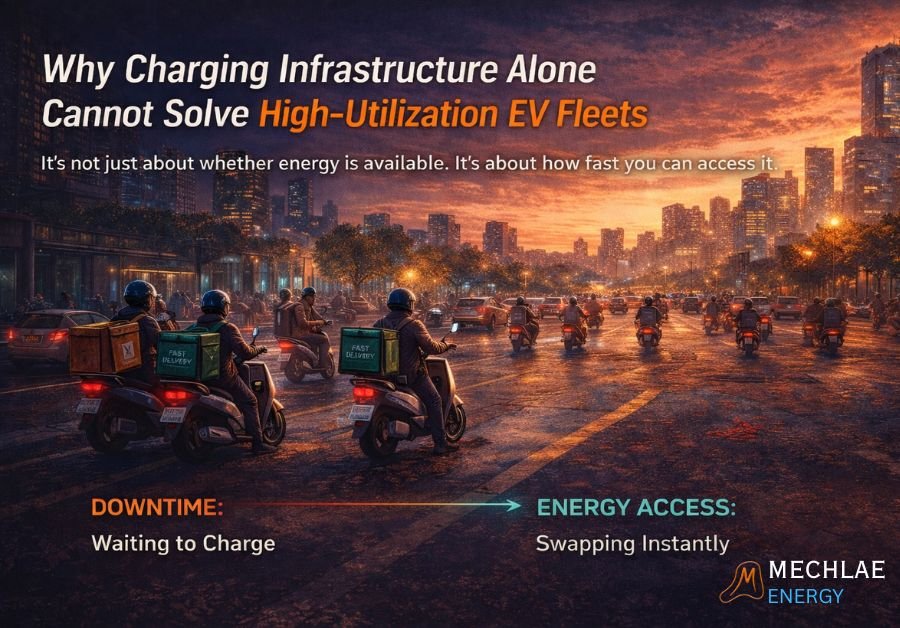
This is where the limitation becomes clear:
- Charging requires waiting, which reduces vehicle utilization
- Fleet operations depend on continuous movement, not scheduled pauses
- Scaling charging infrastructure increases cost and complexity
An alternative approach, such as battery swapping, removes this dependency on time. Instead of waiting, energy is exchanged instantly, allowing vehicles to continue operating with minimal interruption. This improves utilization, stabilizes operations, and makes scaling more practical in dense markets like India.
The larger insight is simple: EV adoption is not just about vehicles it’s about energy delivery. Charging will always be part of the ecosystem, but it cannot alone support high-utilization mobility. The systems that will define the future are the ones that eliminate downtime and make energy instantly accessible.
Because in the end, it’s not about how vehicles get charged
it’s about how they keep moving.